Society of the Adorned Collective (working paper)
Carrie Yodanis
1
In post-industrial society, life can be an immense ongoing work of visual art. Every individual represents their place in an Adorned Collective.[1]
2
The Society of the Spectacle drew attention to the images that replaced actual lived experience. The Adorned Collectivecalls for attention to the images that are created through actual lived experiences.
3
The Spectacle names the psychogeographical, art focused on individual movement combined with observation and interaction, like a joy-filled day walking or bike riding through parks that were once military bases.
4
The Adorned Collective focuses on the socio-geographical, which is very similar to the psycho version but doesn’t emphasize the experiential interaction of the individual walker. Rather the focus is on the collective, seeing a collection of individuals walking, passing, interacting.
5
In both, there is no product, nothing recorded. It is a Fluxus focus on the experience, the process of seeing: process over product. If you miss it, it’s gone. If you see it, it’s gone. Another chance will come.[2]
6
It captures the presence in time, not the past or future but starting now anew and again starting now anew and again starting now anew.
7
The artist often brings people together: through a traditional art exhibition, a staged performance, a public talk. But when there is no artist, people still come together. The Collective focuses on the coming together without the artist; the art is created through chance encounter.
8
The Collective is the interaction that is at the heart of the past, current, and future life of a society; all the stories of encounters and daily interactions between people, some good, some neutral, and some horrid.
9
Anti-fascist art is not waiting for there to be a fascist to overthrow or a regime to tear down. It is rooted in the power to change our interactions with each other, to build more collectively equal and meaningful interactions among people.[3]
10
In June 2024, Marina Abramović called on 7000 people at a music festival to be silent for seven minutes in a collaboration of peace and calm in a time of widespread polarization, hate, and violence. She didn’t know if it would work, but it did.
11
Berlin’s Mauer Park is “on land that ran between the two parallel walls separating East and West Berlin. With its observation towers, attack dogs, trip wires and armed guards primed to shoot anyone trying to escape to the West, it was known as the ‘death strip.’”
12
In June 2024 on a Sunday in Berlin’s Mauer Park, I watched people come together to meet and drink and eat and read and sing and skate and bike and snuggle and graffiti and sell junk and watch people. Today only grilling is strictly verboten.
13
As a friend said as we were walking together, Germany has created these spaces of life and enjoyment out of spaces of pain. It is a way to not forget and not move away, but to also imagine and create something better.
14
As William H. Whyte wrote, people come together, stop, and talk to each other in the most trafficked areas. People crowd together to, in his scientific analysis, “schmooze” in short or longer fleeting encounters.
15
The Adorned Collective is a performance without a script or direction from a leader. But if you watch carefully, as Whyte did, even without an artist, there is a script that pulls people in certain directions.
16
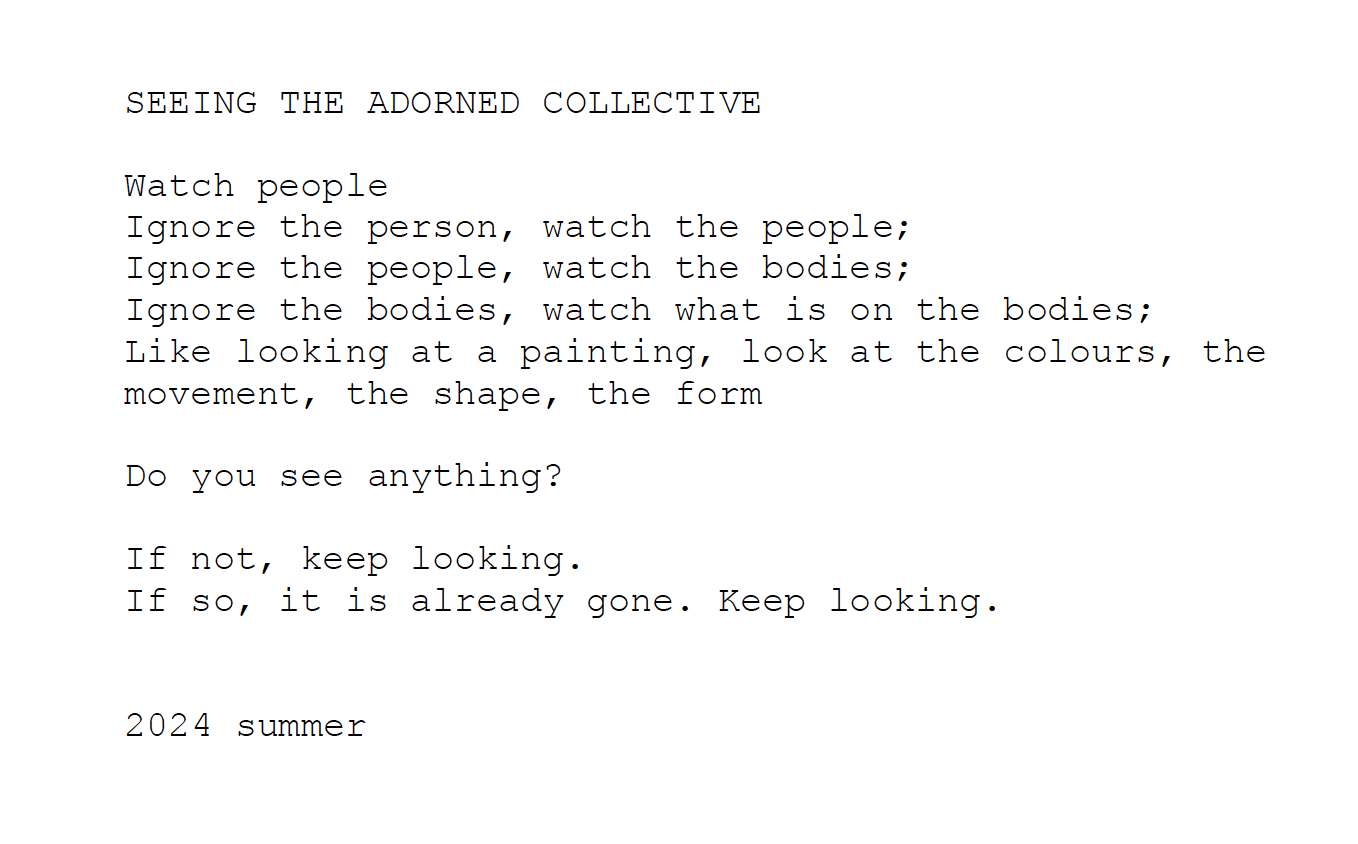
Direction is needed for observation of this performance. The viewer, a participant, likely won’t see it otherwise. These are not rules for how to do it but instructions to free us to be able to. They are cues to pay attention to what we ignore. After separating life and art for so long, encouragement helps us reconnect them.
17
Forming in the place and between the spaces of two world wars, the Bauhaus encouraged art in all everyday things – the spaces we live in, the things we sit on, the objects we use to eat and drink with. Breaking down the divide between life and art make both life and art more whole.
18
Fluxus artists use humour to talk about the social, even among the destruction.
19
The Spectacle is a critique of capitalist culture that replaces people and their interactions with consumer objects. People are replaced by an “endless parade of products.” People are “subjugated” to a “state of having” over a “state of being.”
20
Ornament and Crime by modernist architect Adolf Loos similarly reduces adornment to a waste of resources and labour for the frivolous, trivial, and meaningless.
21
I make shiny things that move as my body does.
22
A British solider liberating Bergen-Belsen in northern Germany described in his diary a large shipment of lipstick arriving to the concentration camp. “We were screaming for hundreds and thousands of other things and I don’t know who asked for lipstick. I wish so much that I could discover who did it. It was the action of genius, sheer unadulterated brilliance. I believe nothing did more for these internees than the lipstick…That lipstick started to give them back their humanity.”[4]
23
Not caring about adorning one’s body is a privilege for those who bodies are socially privileged by virtue of having been born with a privileged body.
24
Bodies become our gallery walls on which we hang materials of meaning. But unlike the static gallery walls of the art world, these displays move around, by, and with other displays out in the world. This can become an image of colour, form, and strokes. As with any work of art, this often isn’t the outcome. Sometimes it is.
25
In this way, adornment is no longer about the individual and their identity. Adornment is about the Collective. We all come together to create the art of the Society of the Adorned Collective.
26
This is a different way of viewing life and society. This is life and society as art, that we are all creating and recreating together for a fleeting moment.
27
Paraphrasing Anni Albers’s On Jewelry: We better know the direction in which we want to go but still not where we will end.[5]
[1] Guy Debold, The Society of the Spectacle. Brooklyn, NY: Zone Books. 1994 [1967].
[2] Kenneth Friedman (Ed.), The Fluxus Reader, Academy Editions, 1998
[3] Michael Puett and Christine Gross-Loh, The Path: What Chinese Philosophers Can Teach Us About the Good Life. New York: Simon and Schuster, 2017.
[4] Linda Grant, The Thoughtful Dresser: The Art of Adornment, the Pleasures of Shopping, and Why Clothes Matter.New York: Simon & Schuster, 2009
[5] Anni Albers, "On Jewelry" at Black Mountain College, March 25, 1942.